
Can AI Personas Predict Human Behavior Under Stress?

AI personas can help explore scenarios and generate research questions. Their responses alone cannot verify how people behave in a specific place under stress. Emergency decisions need human evidence, with a clear distinction between participant accounts, walkthrough observations, and measured exercises.
Ask an AI system how a person will respond when an alarm sounds in a crowded arena. It may generate a confident sequence: read the sign, follow staff directions, leave through the designated exit.
Now change the conditions. The announcement is hard to hear. A staff member points away from the sign. The person is searching for a family member. The crowd starts moving before anyone understands what happened.
The model can generate another convincing answer. But what evidence would tell us whether either answer describes what people would actually do?
That question becomes more urgent as AI enters decisions about emergency preparedness, buildings, and operations. It is increasingly easy to generate a detailed human persona and ask it to evaluate a message or navigate a scenario. The speed is valuable. So is the ability to explore alternatives.
A convincing AI persona can generate useful questions. It cannot, by itself, verify how people respond in a specific place under stress.
Where synthetic personas help
The term 'synthetic human data' covers several methods. A dataset generated from measured human records and validated for a specific task differs from a language model prompted to role-play a person. An LLM persona can also be informed by interviews or other human evidence. Those differences matter: each approach needs evaluation for its intended use.
Generated personas can help planners explore scenarios, identify possible ambiguities in an alert, and prepare questions for interviews or exercises. They can also help teams challenge assumptions before investing in fieldwork.
The risk emerges when a plausible response becomes evidence that a group will understand an instruction or choose a particular route. Generating thousands of simulated responses does not establish how frequently those responses occur among actual people.
In a 2024 study, ChatGPT-generated survey answers resembled human averages on some measures but showed less variation and different relationships between demographic characteristics and responses. A 2026 study evaluating 15 language models across seven social science datasets found that models often compressed human variation into simplified types when given limited demographic information. The latter study also found preliminary evidence that domain-specific training could improve realism. [1][2]
Neither study tested emergency evacuation. They support a narrower, important conclusion: fluent simulation needs independent validation before it can support claims about human populations. The same standard should apply when the consequences involve safety.
Behavior belongs to a person and a situation
Consider a hospital visitor who hesitates to leave because their partner is receiving care. A transit passenger understands an announcement but cannot tell which platform it concerns. A neurodivergent guest knows the exit route yet needs a spoken instruction repeated away from competing noise.
These are illustrative situations, not findings from Access Built's research or predictions based on diagnosis.
They show why the environment matters. A person may respond differently depending on the message, staff actions, familiarity, fatigue, sensory input, relationships, or previous experiences, including trauma. A demographic profile cannot establish how those factors interact in a particular moment.
Research based on interviews and focus groups with World Trade Center evacuees identified influences including risk perception, sensory cues, building familiarity, group behavior, leadership, and communication. These retrospective accounts helped explain how an extraordinary evacuation unfolded. They were not direct observation of every action or a universal prediction of future behavior. [3]
For emergency managers and designers, the practical question is specific: what can people understand and accomplish in this setting, with these instructions and these resources?
Different evidence answers different questions
Access Built's early scenario-based participant research has surfaced accounts involving unclear communication, competing sensory inputs, reliance on social cues, and uncertainty about authority signals. These are exploratory themes in what participants report. They identify experiences to investigate; they do not establish how often a behavior occurs during an emergency.
That distinction should remain visible as evidence moves into a decision system.
Participant accounts explain what people remember, anticipate, notice, or find difficult. Responses about a hypothetical situation describe expectations. Recollections describe remembered events. Both offer valuable context, with limitations including recall, question wording, and who participates.
Walkthroughs allow people to encounter and evaluate a particular space. At Homestead-Miami Speedway, Access Built partnered with The WOW Center to involve people with different abilities in a venue walkthrough. That work brought lived experience into the assessment of entrances, seating, and circulation. A walkthrough can document what people encounter under those conditions. It cannot establish their response to smoke, an alarm, or an actual evacuation. [5]
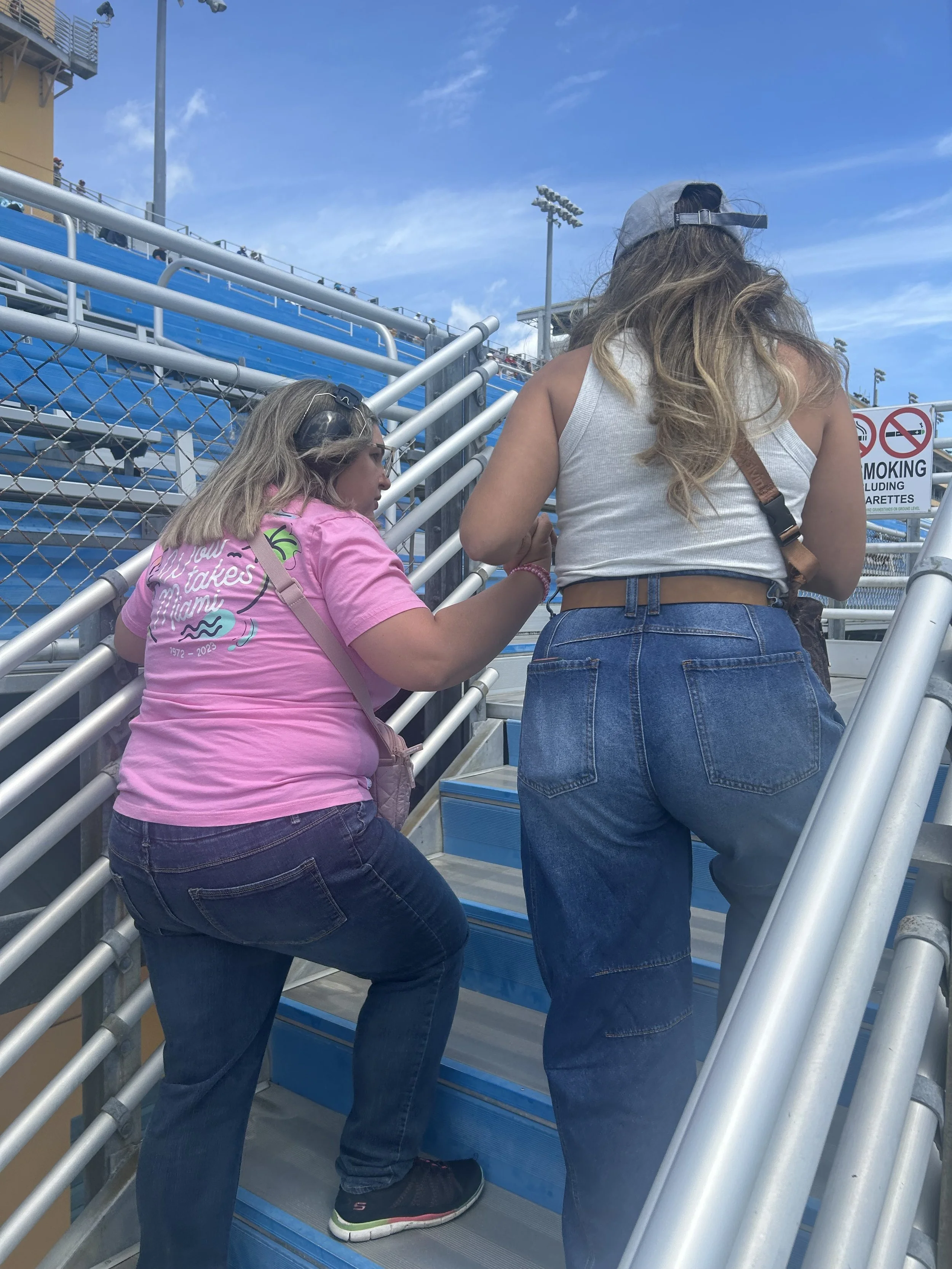
Access Built's walkthrough with The WOW Center brought lived experience into a venue assessment. This was a walkthrough, not an emergency evacuation test.
Drills and exercises can provide observations or measurements of actions under defined test conditions. An observed delay or missed instruction is evidence about that exercise. Whether the finding transfers to a real incident depends on the participants, scenario, realism, and setting. A discussion-based tabletop exercise provides a different kind of evidence from an observed evacuation drill.
Incident records and survivor accounts can add evidence about actual emergencies. They also contain gaps and retrospective uncertainty. Confidence comes from understanding these differences and testing whether findings hold across sources and settings.
Lived experience is expertise

Access Built and The WOW Center at Homestead-Miami Speedway. People with lived experience contribute expertise about the spaces they use.
People who regularly navigate cognitive, sensory, communication, or mobility friction bring knowledge that a model may never be prompted to consider. They can explain adaptations they have developed, signals they trust, and why an apparently helpful instruction creates another problem.
Their contribution should help shape the research questions, participation methods, interpretation, and proposed changes. Appropriate compensation and clear choices about data use should be part of that relationship.
No individual represents everyone with the same diagnosis or disability. Differences within groups deserve attention, including experiences that contradict the expected pattern. Those exceptions may reveal where a system fails.
FEMA's whole-community approach recognizes that preparedness depends on communities contributing their needs and capabilities to planning. Generating an artificial community voice cannot fulfill that participation. [4]
What AIDE is building
Access Built is building AIDE as a behavioral risk intelligence system for emergency planning and operations. Its purpose is to connect evidence informed by lived experience with the specific plans, communications, and environments an organization depends on.
This makes the analysis more useful to decision makers. If a plan assumes staff will direct guests to an alternate route, a review should examine whether the message is understandable, whether other signs contradict it, and whether staff will actually be available. Participant accounts can identify questions a document review might miss. Site observation and exercises can then test relevant assumptions.
The research and the system are still developing. AIDE's current work does not establish validated probabilities of individual behavior or demonstrate that its recommendations improve emergency outcomes. Its immediate value is helping teams identify possible friction and decide what warrants investigation.
The development goal is to distinguish clearly between participant reports, documented observations, measured exercise results, and analytical inferences. Each finding should retain its source, context, and limitations. Any future predictive claim must be tested against human evidence that was not used to build or tune the prediction. Agreement between generated personas is not that independent test.
The value is in better decisions
For a venue or hotel, evidence might justify testing conflicting directions between an announcement, a sign, and staff. For healthcare, it could expose an assumption that every visitor can leave immediately. For transportation, it might reveal that a route change is communicated without giving passengers a workable next step. Cities face similar questions about warnings, transportation, and shelter access.
The value of a human dataset grows when well-documented experiences help organizations ask better questions, prioritize changes, and evaluate whether those changes work. That requires consistent methods, appropriate sampling, quality checks, and validation. More responses alone do not establish representativeness, and running more simulations does not independently confirm their assumptions.
Before using an AI-generated persona to justify a safety decision, ask: which findings come from actual people? What was reported, observed, or measured? How closely does that evidence match the population, place, and conditions involved?
A useful simulation gives us something to investigate. Human evidence lets us test whether we should believe it.
If your team is reviewing an emergency plan, choose one scenario and examine its assumptions about what people will hear, understand, and do. Talk with Access Built about a focused readiness review to identify which assumptions need closer testing.
Article source links
Synthetic Replacements for Human Survey Data? The Perils of Large Language Models, Political Analysis, 2024.
Evaluating the statistical realism of LLM-generated social science data, PNAS, 2026.
Factors associated with high-rise evacuation: qualitative results from the World Trade Center Evacuation Study, Prehospital and Disaster Medicine, 2007.
Homestead-Miami Speedway case study, Access Built. Supports the described partnership and walkthrough activities, not emergency outcomes.
